Why Video Note-Taking Is Different
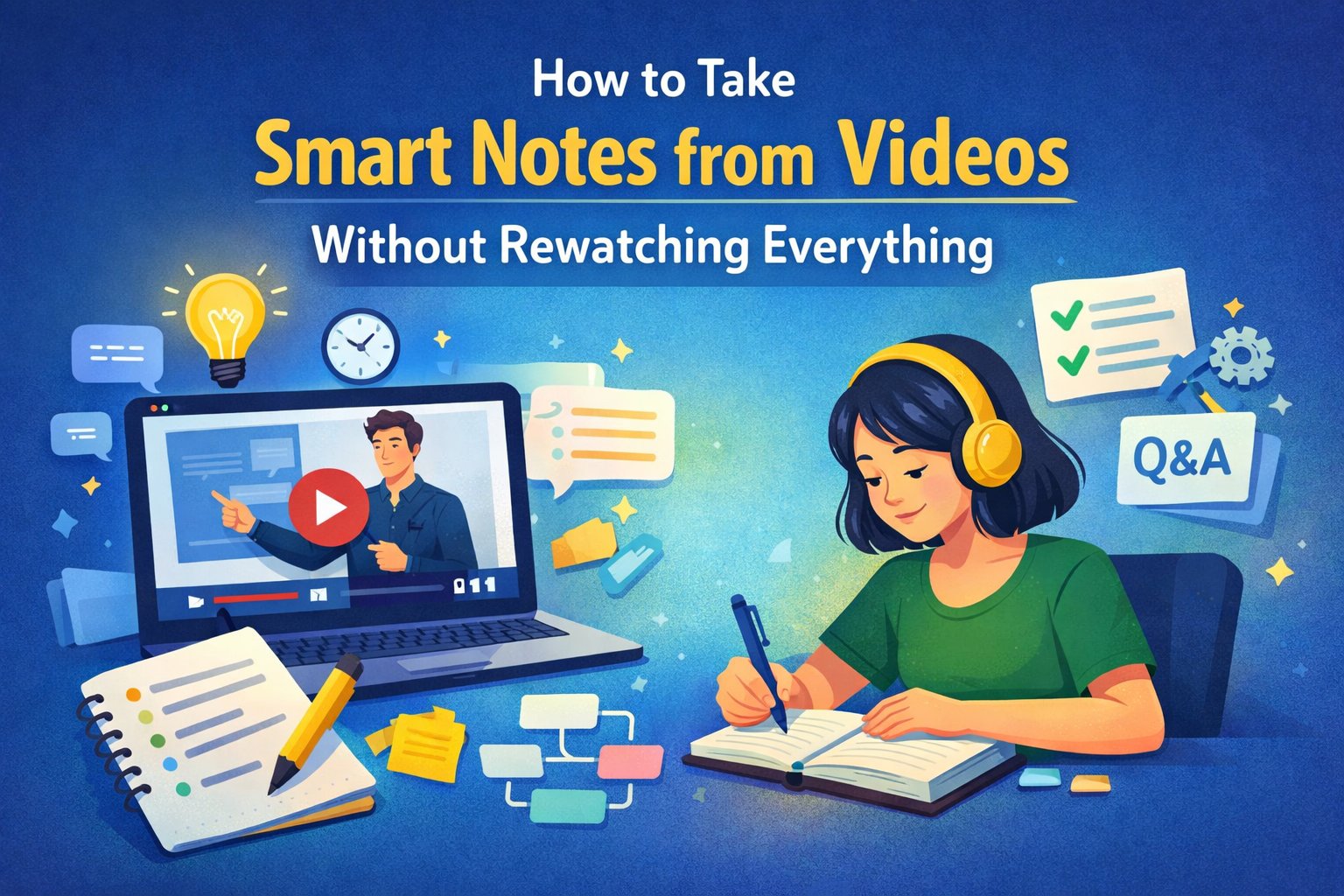
Unlike textbooks or articles, videos move forward whether you’re ready or not. You can’t skim easily, and important ideas can be missed if you lose focus for just a few seconds.
That’s why good video note-taking requires:
- Active attention
- Clear structure
- Smart use of tools
Once you adjust your approach, videos become one of the most powerful learning formats available.
Step 1: Define Your Purpose Before Watching
Before pressing play, ask yourself one simple question:
“What do I want to learn from this video?”
Write down:
- The topic or title
- Why you’re watching it
- What you expect to gain (key concepts, exam prep, skill practice, etc.)
This creates a mental filter so you focus only on information that matters — instead of trying to capture everything.
Step 2: Break the Video into Sections
Instead of treating the video as one long piece of content, divide it into parts.
You can:
- Use visible chapter markers (if available)
- Create your own sections based on topic changes
- Add timestamps next to your notes
This makes your notes easier to review later and helps you quickly return to specific moments without rewatching the entire video.
Step 3: Listen for Ideas, Not Sentences
One of the most common mistakes learners make is trying to write down exactly what the speaker says.
Instead:
- Focus on ideas and explanations
- Write short phrases or bullet points
- Use your own words whenever possible
If you can explain the concept in your own language, you’re already learning — not just copying.
Step 4: Pause Strategically (Not Constantly)
Pausing is useful, but overusing it breaks your focus.
A better approach:
- Watch a short segment (1–3 minutes)
- Pause and write down key points
- Resume without immediately replaying
If something is unclear, then rewind. This keeps your attention on understanding rather than perfection.
Step 5: Use Visual Signals in Your Notes
Your notes should be easy to scan later.
Try using:
- Bold text for main ideas
- Symbols like ⭐ for important concepts
- Indentation for supporting details
- Simple diagrams for processes or comparisons
Visual organization saves time when reviewing and helps your brain recall information faster.
Step 6: Summarize After the Video Ends
The most powerful learning happens after the video.
When you finish watching:
- Write a short summary (3–5 lines)
- List key takeaways
- Note any questions you still have
This step strengthens memory and reveals gaps in understanding while the content is still fresh.
Step 7: Turn Notes into Study-Ready Material
Raw notes are useful, but structured notes are even better.
You can:
- Convert key points into flashcards
- Create a checklist or outline
- Group related ideas together
This makes your notes reusable — especially for revision, exams, or future projects.
How Kardly.ai Makes Video Learning Easier
Manual note-taking is effective, but it can also be time-consuming. Kardly.ai helps by transforming video content into:
- Clear summaries
- Structured notes
- Flashcards you can review anytime
Instead of rewatching videos repeatedly, you can focus on understanding and retention — faster and more efficiently.
Final Thoughts
Taking notes from videos doesn’t have to feel chaotic or exhausting. With the right strategy, you can turn any video into organized, meaningful knowledge that sticks.
Focus on purpose, structure, and clarity — and let your notes work for you, not against you.
Ready to learn smarter? Kardly.ai is built to help you do exactly that.
More from the Kardly Blog
Continue reading related study strategies, AI learning guides, and product updates.
How to Study for Exams with AI: A Step-by-Step Guide
Most students study the same way: read the notes, highlight, maybe make some flashcards, re-read the night before. It’s the method we were all taught,…
The Best Free Quizlet Alternative in 2026 (AI-Powered)
Quizlet built its reputation on one simple idea: students will study more if studying feels like a game. And for a while, it worked. But students in 2026 hav…
How to Turn a PDF into Flashcards for Free (In Under 3 Minutes)
Making flashcards by hand takes forever. You read a paragraph, decide what’s important, write a question, write the answer, and repeat — for every sing…
How AI Tools Are Changing the Way Students Study (And Why You Should Switch)
Something changed in how students study — quietly, without much announcement. The students getting top grades in 2026 aren’t necessarily working harder…
How to Take Better Notes While Reading (and Actually Remember What You Read)
Taking notes while reading isn’t just something students do — it’s one of the most powerful ways to understand, retain, and use what you read. Whet…
Ready to Start Learning Smarter?
Transform your study materials into AI-powered flashcards and summaries in seconds.
Try Kardly Free